
Breaking the Freeze (and Breaking Out of the Standard Dosage Box) by Calli Hutchison, PT, DPT
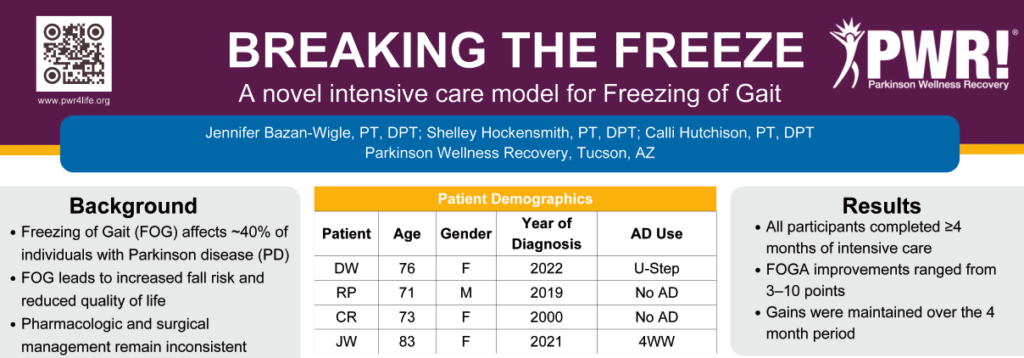
If you work with people with Parkinson’s disease, you’ve probably experienced the frustration of treating Freezing of Gait (FOG).
FOG affects nearly 40% of people with PD and tends to become more prevalent as the disease progresses. It can be unpredictable, contribute to falls, and have a significant impact on a person’s confidence and independence. Unfortunately, FOG also tends to be a particularly challenging symptom to manage, and research suggests some individuals have difficulty retaining improvements they make in therapy compared to those without FOG.
The traditional outpatient plan of care often defaults to two visits per week for 6-8 weeks. While that structure works well for many conditions, PD – and especially FOG – may require a different dosage strategy, particularly when retention, intensity, and reimbursement all need to be considered.
That led us to a question: What if people with FOG do not need more therapy overall, but instead need the same skilled therapy delivered in a more concentrated, strategically timed way?
That’s when we tried the FOG intensive. Patients completed 3-5 consecutive days of physical therapy, followed by a break, and then returned for another intensive on a recurring monthly basis. Rather than increasing the total number of visits, this model redistributed visits across the plan of care to better support neuroplasticity principles of intensity, repetition, and retention.
So, does it work? We followed four individuals with PD and FOG who participated in this model for at least four months. All four demonstrated improvements on the FOG Assessment, with scores improving by 3-9 points, and they maintained mobility gains while experiencing fewer falls during the four-month period. Although this small case series is not sufficient to establish effectiveness, the consistency of the observed improvements was strong enough to justify further evaluation of how therapy dosage is structured for this population.
We’re continuing to use this model at the PWR!Gym because we’re seeing results impressive enough that we shared them through poster presentations at CSM and WPC. Importantly, the model has also proven feasible from a reimbursement standpoint. Intensive care models can be perceived as unrealistic within outpatient billing structures, but this approach has been delivered as skilled physical therapy with successful reimbursement.
That means clinicians do not necessarily have to choose between providing patient-centered care and working within the healthcare system. With clear documentation of clinical need, skilled reasoning, and individualized dosage planning, therapy can be structured in a way that is both clinically meaningful and operationally viable.
Our small case series suggests that periodic, high-frequency PT intensives may be a promising way to improve FOG and help people maintain their gains. Larger studies are still needed to compare this model directly with traditional therapy frequencies, but the early results support piloting the approach more intentionally and tracking outcomes prospectively.
Because sometimes the best plan of care is not the one we have always used. It is the one that best matches how the patient learns, responds, and maintains meaningful gains.